
ROASTED CAULIFLOWER AND CHICKPEAS WITH BUTTER BEAN MASH
A platter that tastes like home: roasted cauliflower and chickpeas on lemony butter bean mash, with a fresh herb, cucumber and pomegranate salad.

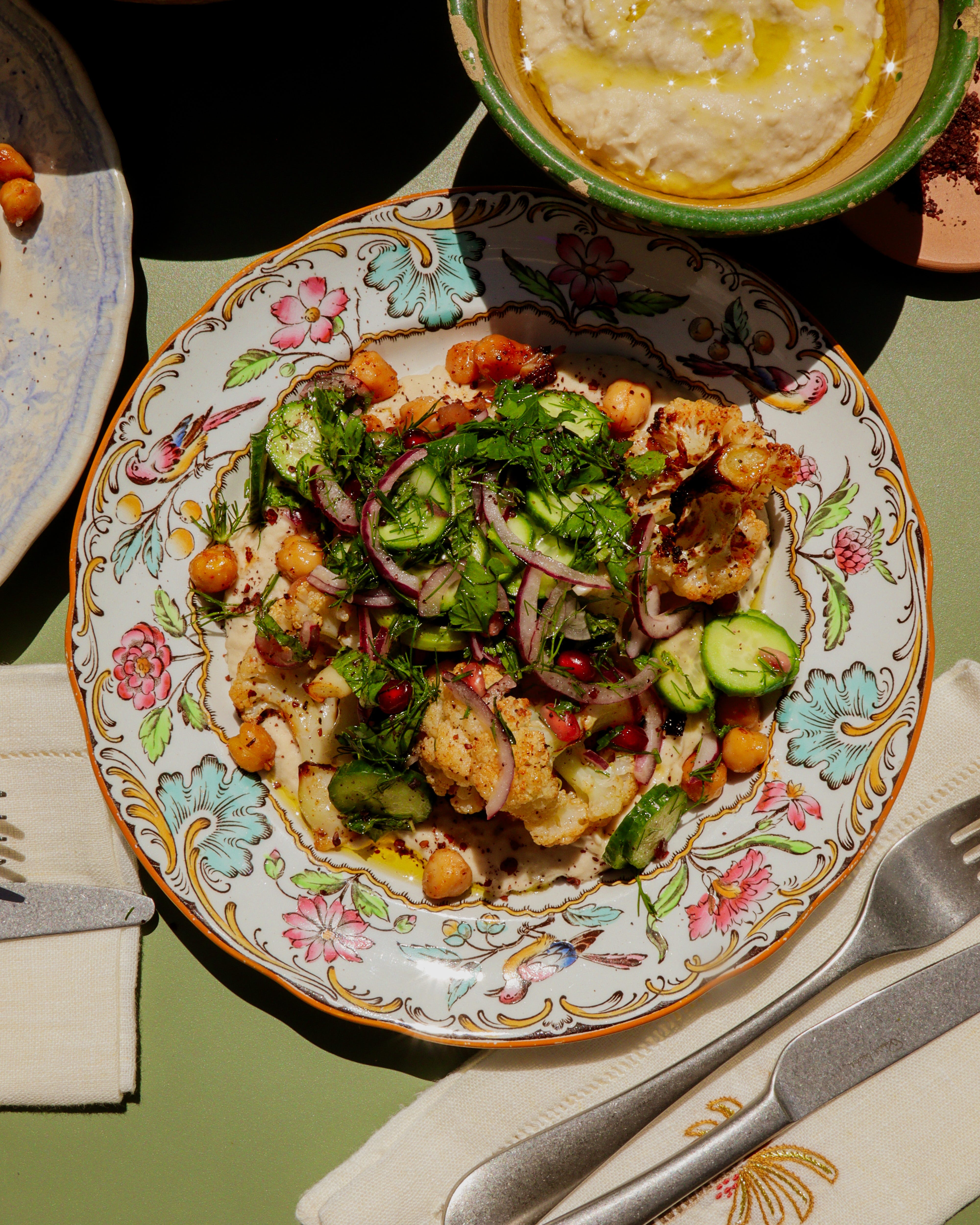
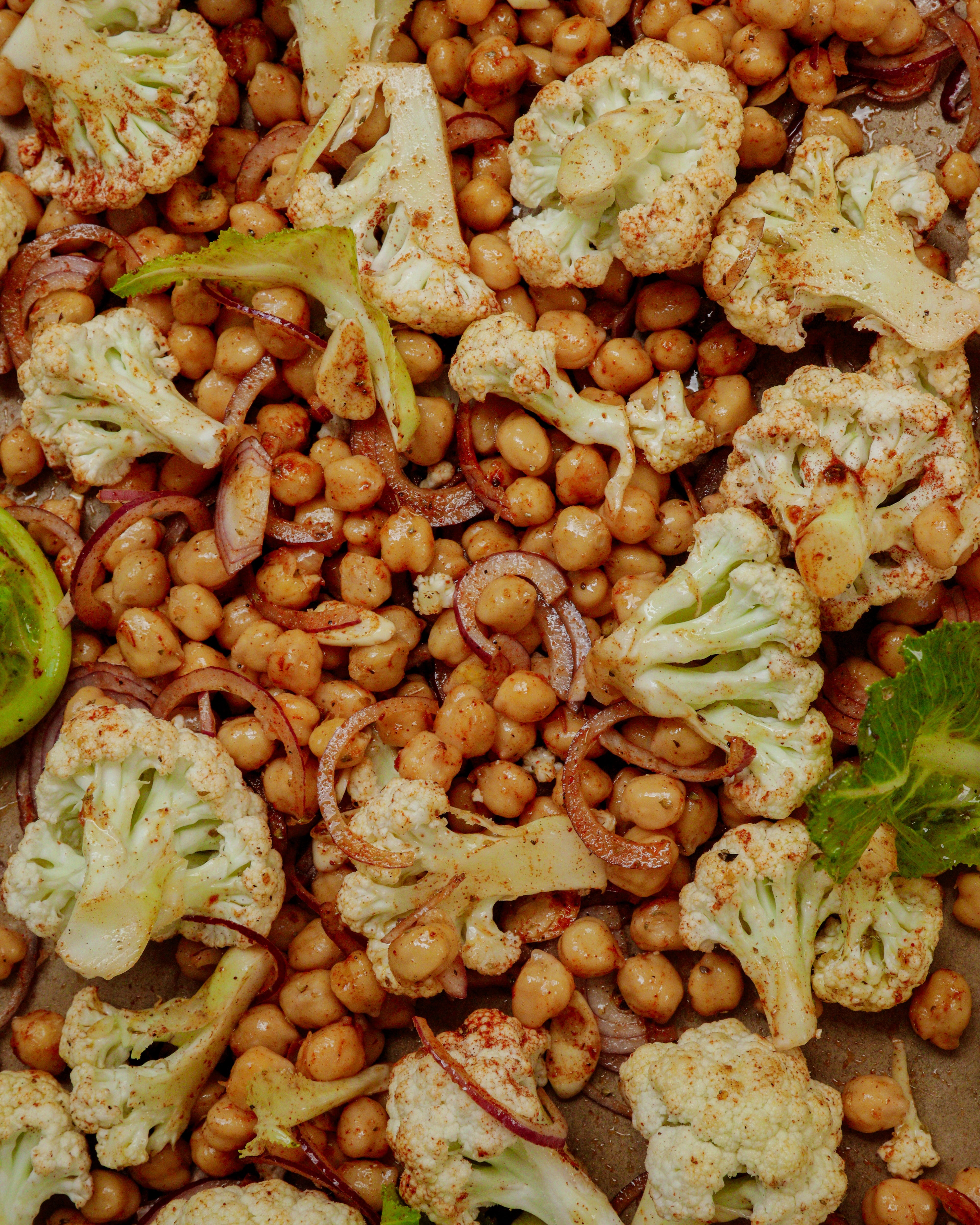
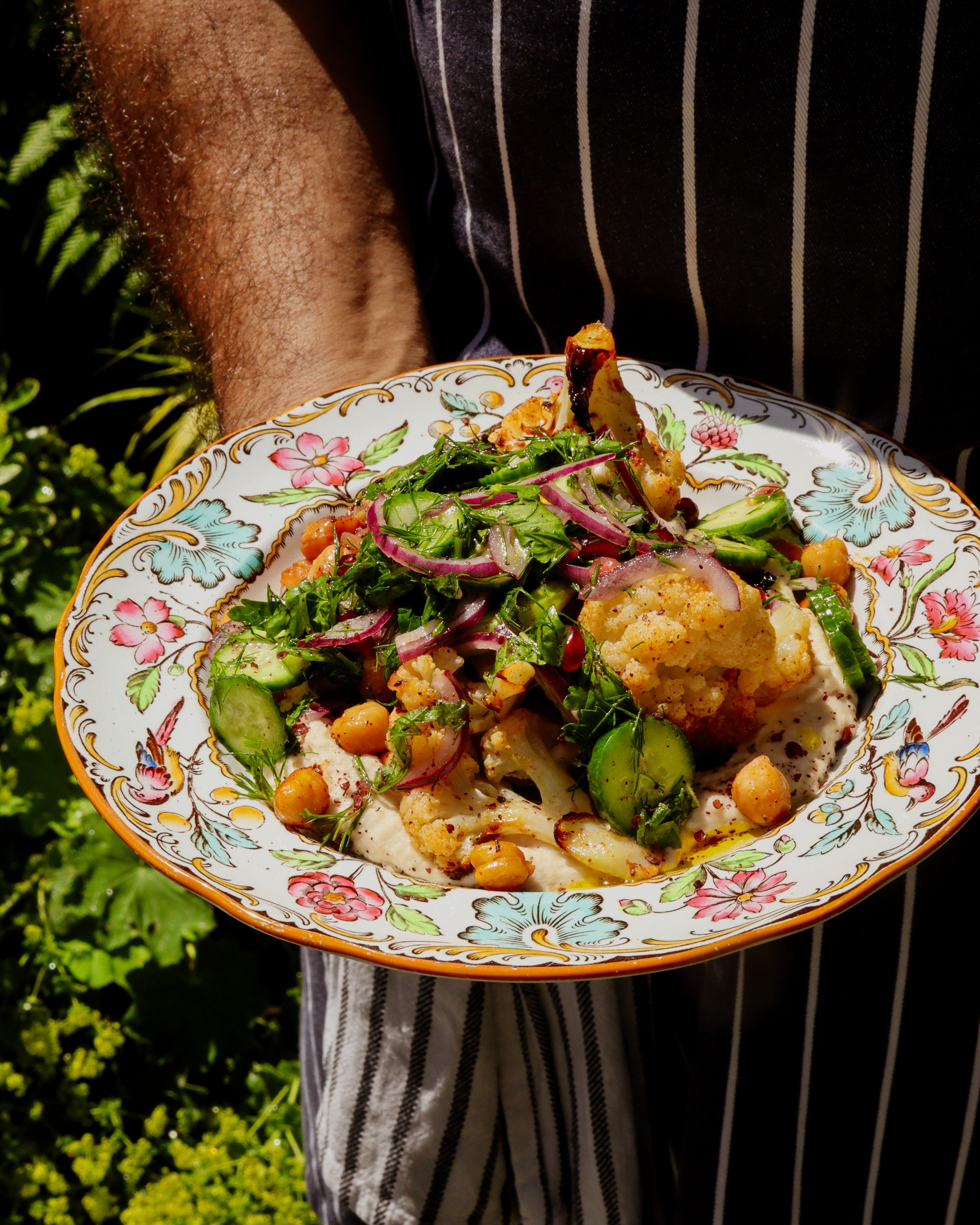
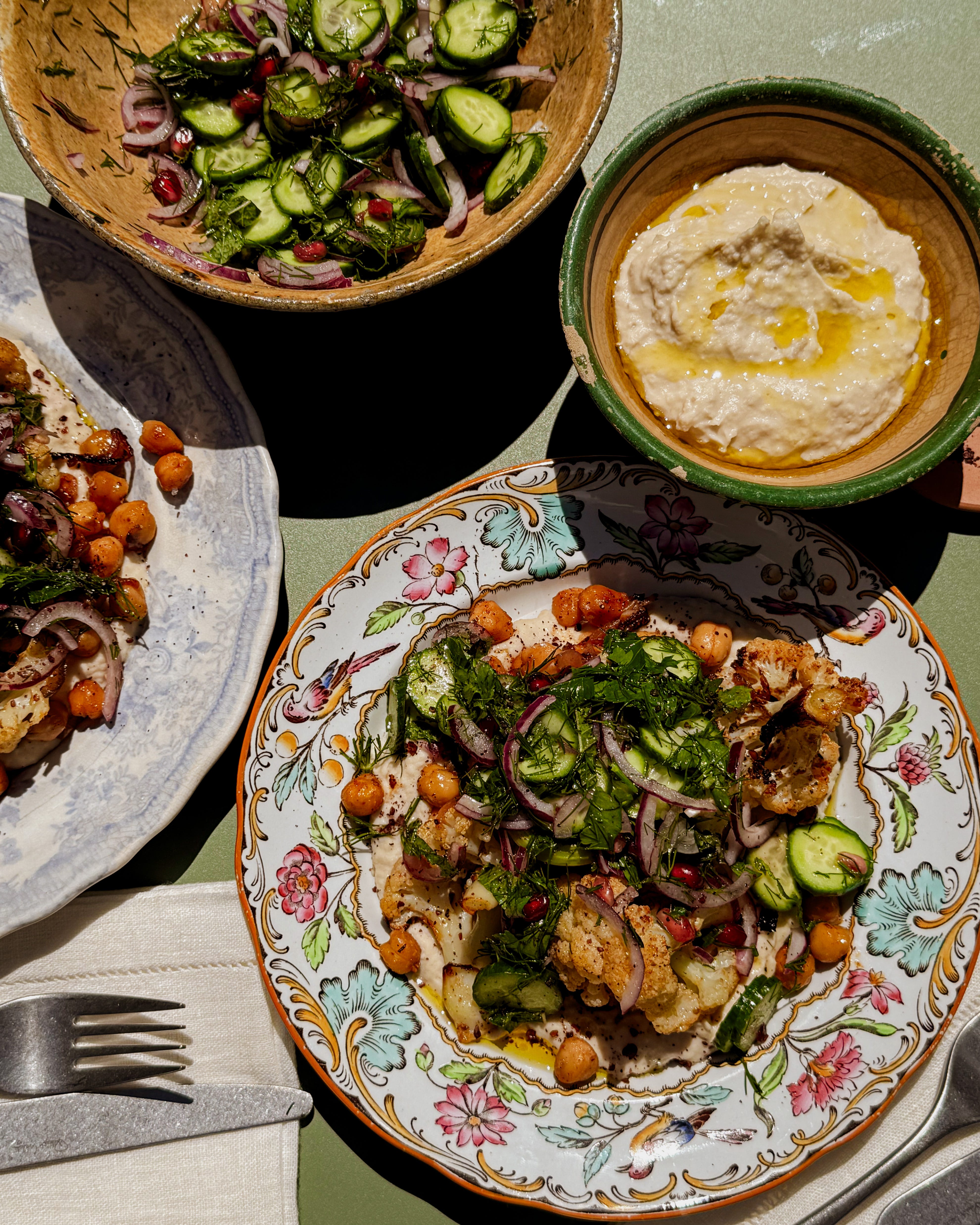
A whole tray of cauliflower florets and chickpeas roasted with red onion, smoked and sweet paprika, and oregano until the edges of the cauliflower are dark and the chickpeas have crisped. Underneath, a creamy butter bean mash made with tahini, lemon and garlic. On top, a cool sharp salad of Lebanese cucumbers, pomegranate, red onion, mint, dill, parsley and sumac.
A platter of food that tastes like home. I can’t stop thinking about it.
Let me get one thing out of the way, because you are reading this in July and you are already thinking it: this recipe asks you to turn your oven on in high summer and that is not the most welcome instruction I could be giving you.
I have thought about this and this dish is definitely worth it. The whole magic of it is what happens to the cauliflower when it roasts hot and hard, the way the florets catch and darken at the edges; the outside goes crisp, the inside stays tender. It’s addictive. You cannot get any of that from a pan on the hob. You cannot get it from a steamer. You need the dry heat of a hot oven for the exact time it takes to do the work.
There is, however, one alternative I want to mention, because it is genuinely good. If it is a summer weekend and you already have the barbecue going, you can do this on the charcoal instead. Toss the cauliflower and chickpeas with the oil and spices as the recipe suggests, spread them out in a single layer on a large sheet of foil or a barbecue tray and cook them over medium-hot coals for about the same length of time, tossing occasionally. The charcoal adds a smokiness that the oven cannot give you, making it even more irresistible. If you have the option, I would take it. If not, twenty-five minutes with the oven on will not kill you. Yalla. Open a window. Pour yourself something cold. It will be worth it.
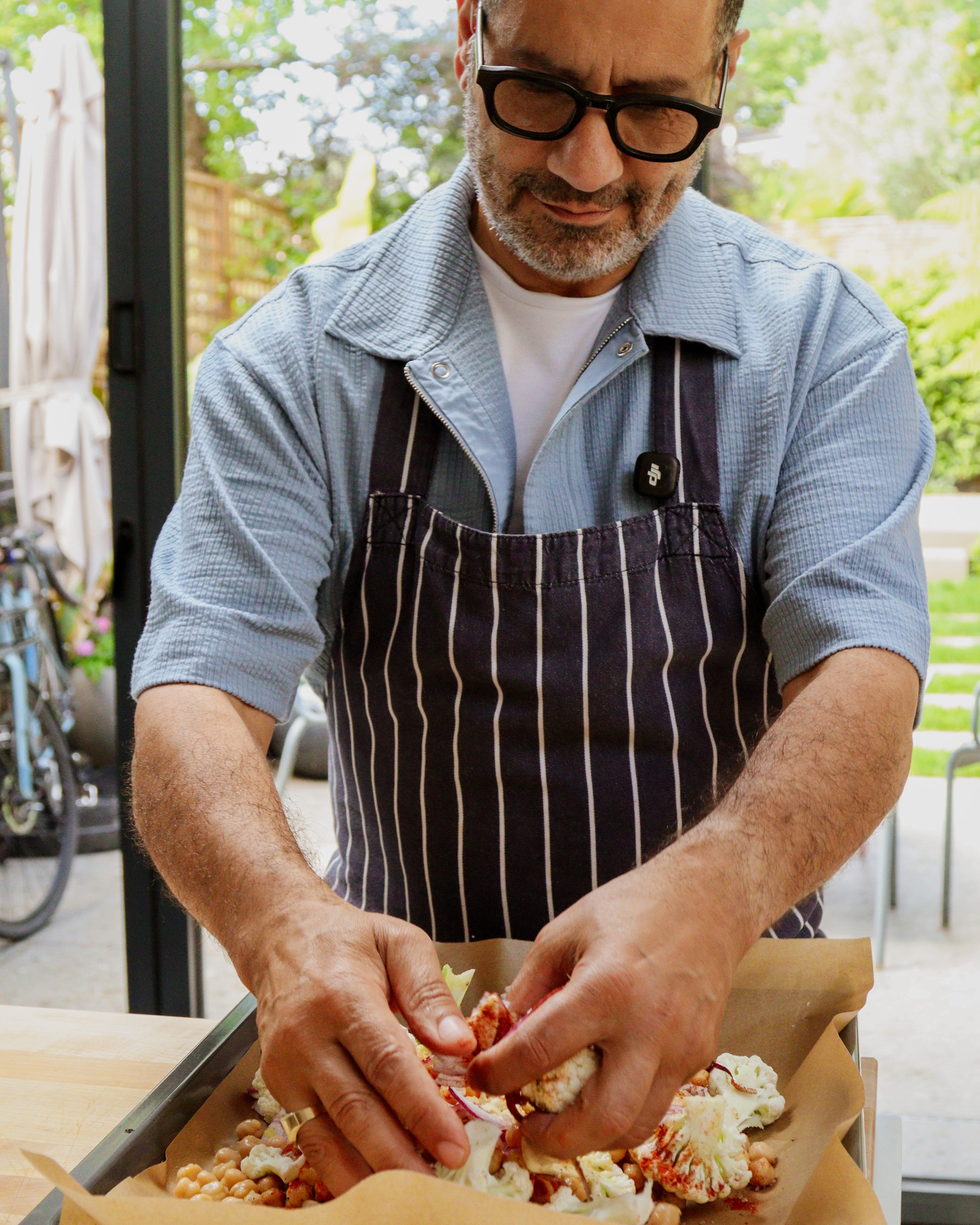
In Palestine, we grow one type of cauliflower. It is called zahara baladi - heirloom cauliflower, or, more literally, “the cauliflower of the land.”
Baladi is a small word that does a great deal of work in Arabic. It means, straightforwardly, “local” or “of my country” - the same root gives you balad, meaning homeland or town. But when it is attached to a vegetable or a way of farming, it means something more specific. It means grown from local seed, in local soil, according to traditional methods. It has been done this way for thousands of years and these varieties are the ones that have adapted, generation by generation, to survive the particular soil, weather and pests of the land they grew up in. I should say, too, that in recent decades the word baladi itself has been widely adopted in Israeli food and farming culture, appearing on menus and labels and in cookbooks to signal much the same thing: local, traditional, of the land. However, what tends not to travel with the word is any acknowledgement of the Palestinian practices, seed varieties and communities that gave it its meaning in the first place.
In practice, in my country, baladi almost always means rain-fed. If the rains come, the crop comes. If they do not, the crop does not. Zahara baladi is a small annual miracle of this system. The seed is sown in the spring. The plant then takes almost a full year to mature, not the two or three months of a modern hybrid cauliflower, but a slow, rain-fed, patient year. The variety grows best in the cooler areas of the West Bank, where the winter rains still come reliably enough to support it. When the heads finally arrive, in a short window at the end of that long cycle, they are like nothing you can buy in a British supermarket. The colour is a soft yellow rather than white. The flesh is denser, creamier, with a distinct mustardy note that goes deep into every bite. The long stems, which most cooks in this country throw away, are eaten raw as a snack. And the robust green leaves, warak shawl, are highly prized. In season they are sold in the markets as a separate vegetable, stuffed with rice, chickpeas, herbs and spices, rolled tight and simmered in a lemon and olive oil broth. In Palestine, no part of it is wasted. It has taken too long to grow to be treated carelessly.
The three-week window when this cauliflower is in the markets is one of the small annual joys of the Palestinian food calendar. My mother knew when it was coming. My aunts knew. The greengrocer would tell you the moment the first heads arrived. And for those three weeks, it was cooked in every way we knew how: roasted whole, fried in fritters, simmered with lamb, stuffed, pickled. Those three weeks were a celebration.
Something has happened to the cauliflower in the last fifteen years or so, in Britain and across the West and I want to note it because it makes me quietly happy. When I first moved to this country, it was considered a slightly embarrassing vegetable. It was the pale, faintly damp thing that appeared on school dinner plates underneath cheese sauce. It was what your grandmother served when there was nothing more interesting available. Serious cooks did not build meals around it.
Then, all of that changed. Somewhere in the 2000s, some two chefs in some deli in Notting Hill started to serve the cauliflower that was treated as a proper ingredient; roasted, displayed on a platter with tahini, pomegranate like a piece of art. The reason I bring this up is not to be smug about it, or to blow my own trumpet. It is to note, with a certain amount of warmth, that we Palestinians have always known what the cauliflower was capable of. We have been roasting florets in olive oil and spice for centuries, frying them for arnabeet fritters with tahini, stuffing them, layering them with rice, folding them into stews, since long before any of this became a staple in the so-called West.
A memory has come back to me while writing this:
When I was about eight or nine years old, my father sent me to the market to buy a zahara baladi. He was very particular about which one I was to bring back. Big, he said. Yellow. Firm. Ask the greengrocer for the best one. I walked to the market alone, which is what children did then. I stood in front of the pile trying to look like someone who knew what he was doing.
The greengrocer took pity on me and picked the biggest one himself. It was, I remember very clearly, the size of my head. It might have been slightly bigger. I could not carry it in one hand, and I could not fit it into any bag I had, so I carried it home in both arms, cradled against my chest like a very heavy baby, walking slowly down the streets and stopping every so often to rest my arms. People noticed. One old man laughed and told me I was carrying home the family’s lunch. Which I was.
My mum cooked it that day, I no longer remember exactly how. What I remember is the walk home, the weight of the thing and the pride of being the one who had brought it back. I must have looked ridiculous. It was one of the small triumphs of my childhood. I still think of that cauliflower every time I roast one now, even in a London kitchen, with an ordinary white supermarket head that a zahara baladi would have completely outshone.
Now, yalla, let’s cook.
RECIPE: Roasted Cauliflower and Chickpeas with Butter Bean Mash
Serves 4
