STUFFED ONION YALANJI
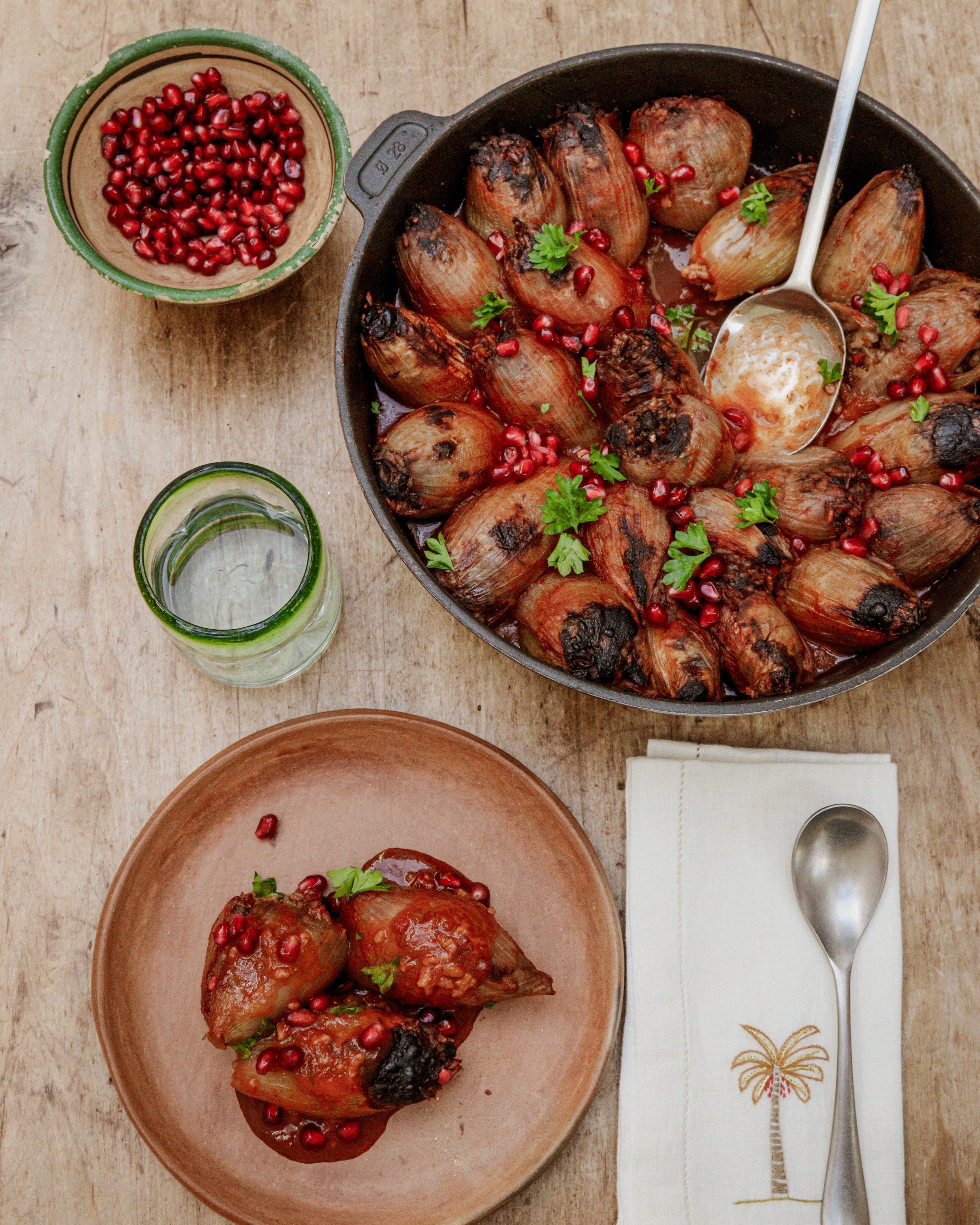
Palestinian onion dolmas stuffed with rice, herbs and pomegranate molasses, baked slowly until deep brown and sweet. Traditionally, entirely vegan. Entirely delicious.

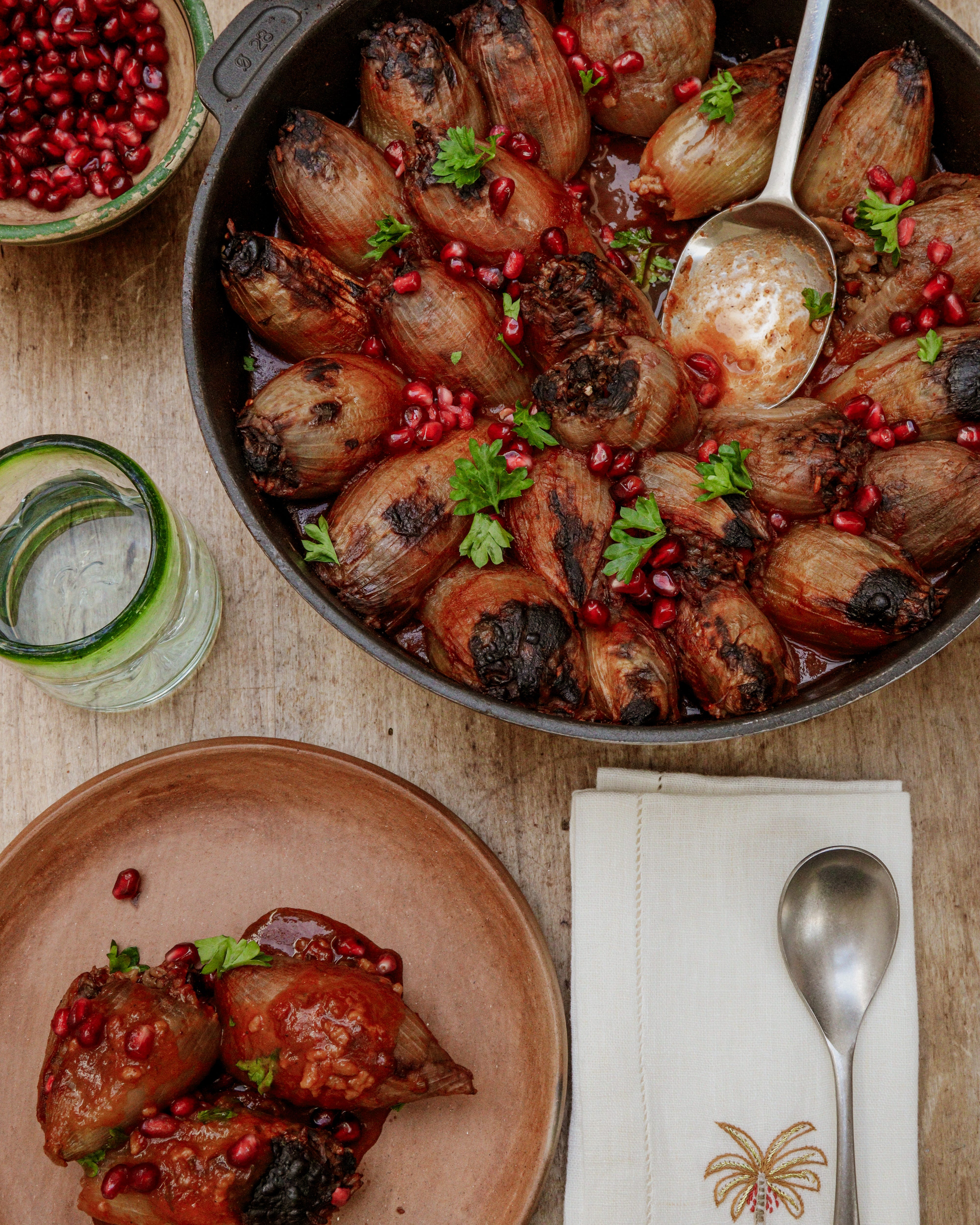
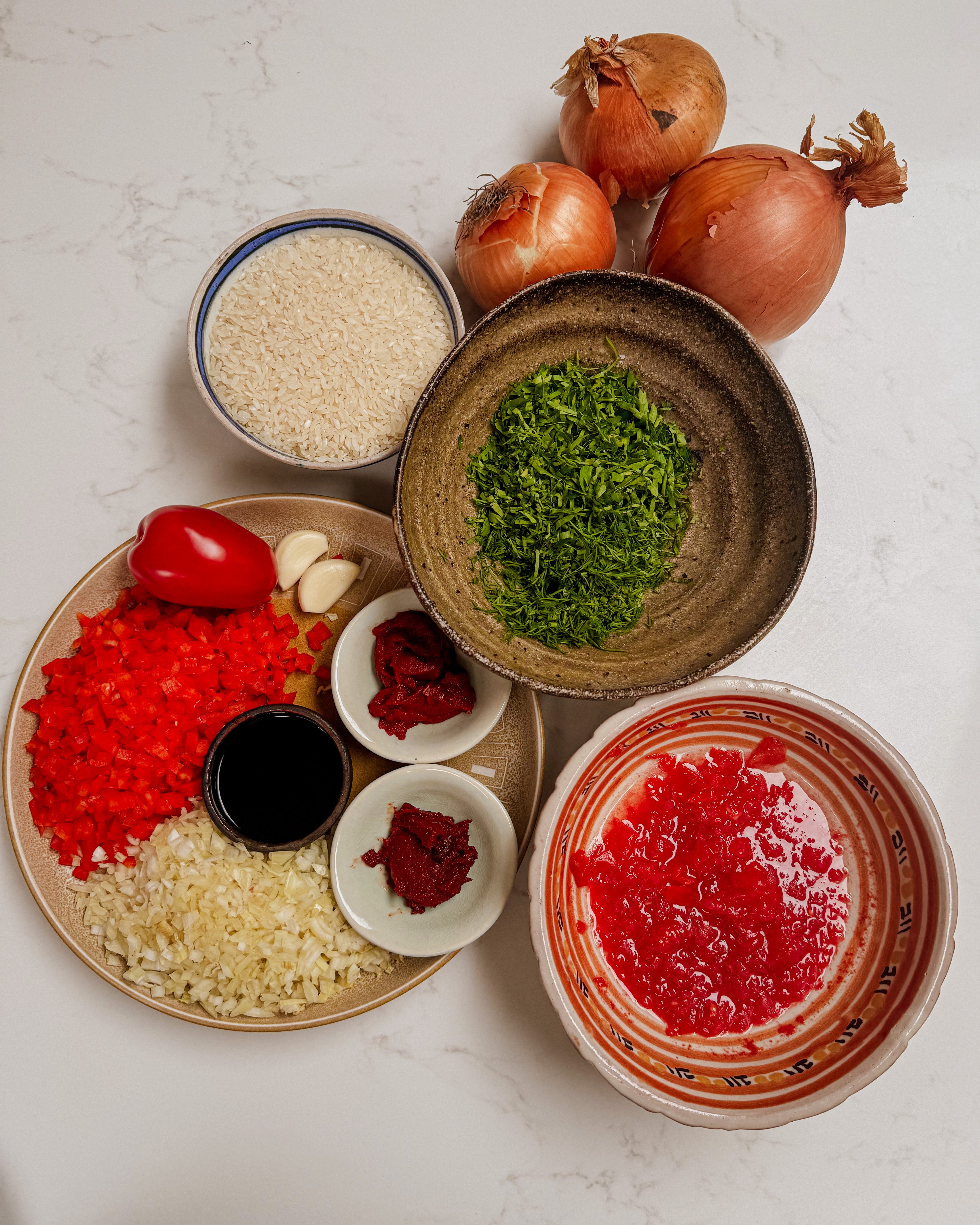
Just a handful of ingredients make a dish that is unlike anything else. Humble onion stuffed with a delicious filling of rice, red pepper, grated tomato, parsley, dill and mint, sharpened with pomegranate molasses and lemon, then baked slowly until golden brown. Simple, yet packed full of flavour. In other words: I want to eat it all the time.
Here is the important instruction, the opposite of what I would usually tell you: you don’t have to rush it to the table. This dish is at its best cold. Everything about it is designed to improve while you sleep. Make it today, eat it if you’re hungry. Or let it cool, put it in the fridge overnight, have it tomorrow with a dollop of yoghurt on the side. In this weather, there is nothing better.
First things first: this is essentially a dolma, from the Turkish dolmak, to be filled. The family covers anything that can be packed with a seasoned filling of rice and, more often than not, minced lamb. Hollowed courgettes, aubergines, peppers, tomatoes and onions get stuffed; vine leaves and cabbage leaves get rolled around the filling instead, which strictly speaking makes them sarma, from the verb to wrap.
This family of dishes runs through the old Ottoman world and beyond it. Say the word dolma anywhere between Athens and Baku and you will be understood, but you will also be corrected: dolma and sarma in Turkish, dolmades in Greece, tolma in Armenia, sarme through the Balkans, mahshi and yalanji and waraq enab across the Arab Levant, all of it echoing further east into Iran and Azerbaijan.
The name of this particular dolma is a small joke that has lasted several hundred years.
Yalanji comes from the Turkish yalancı – liar, faker, impostor. These are the ‘fake’ dolma: the ones that look exactly like the meat-stuffed originals, are rolled by the same hands, but contain no meat at all. The dolma that is pretending.
I have always loved that it is named after a deception rather than after its ingredients. And notice what the naming gives away. Nobody ever needed a separate word for the meat version - that one is just dolma. It is the meatless one that had to be flagged and flagged as a counterfeit, which tells you exactly where the hierarchy sat. Lamb was the assumed centre of the dish. Take it out and you were not making a different dolma. You were making a pretend one.
But the joke has aged in an interesting direction, because it developed a personality entirely its own. It turns out to be a personality people love more.
Meat dolma is rich, cooked in stock or with butter, often served hot. Yalanji went the other way completely - built on olive oil rather than heavy fat, it is sharp and it is eaten warm or at room temp. It is a mezze. It also has some connection to religious traditions. Arab Christians eat yalanji through Lent, when meat and dairy are set aside for weeks. It is also popular during Ramadan, on iftar tables that need dishes which can be made in the afternoon and eaten at sunset. Good to mention that it is, without ever having been designed as such, entirely vegan and has been for centuries.
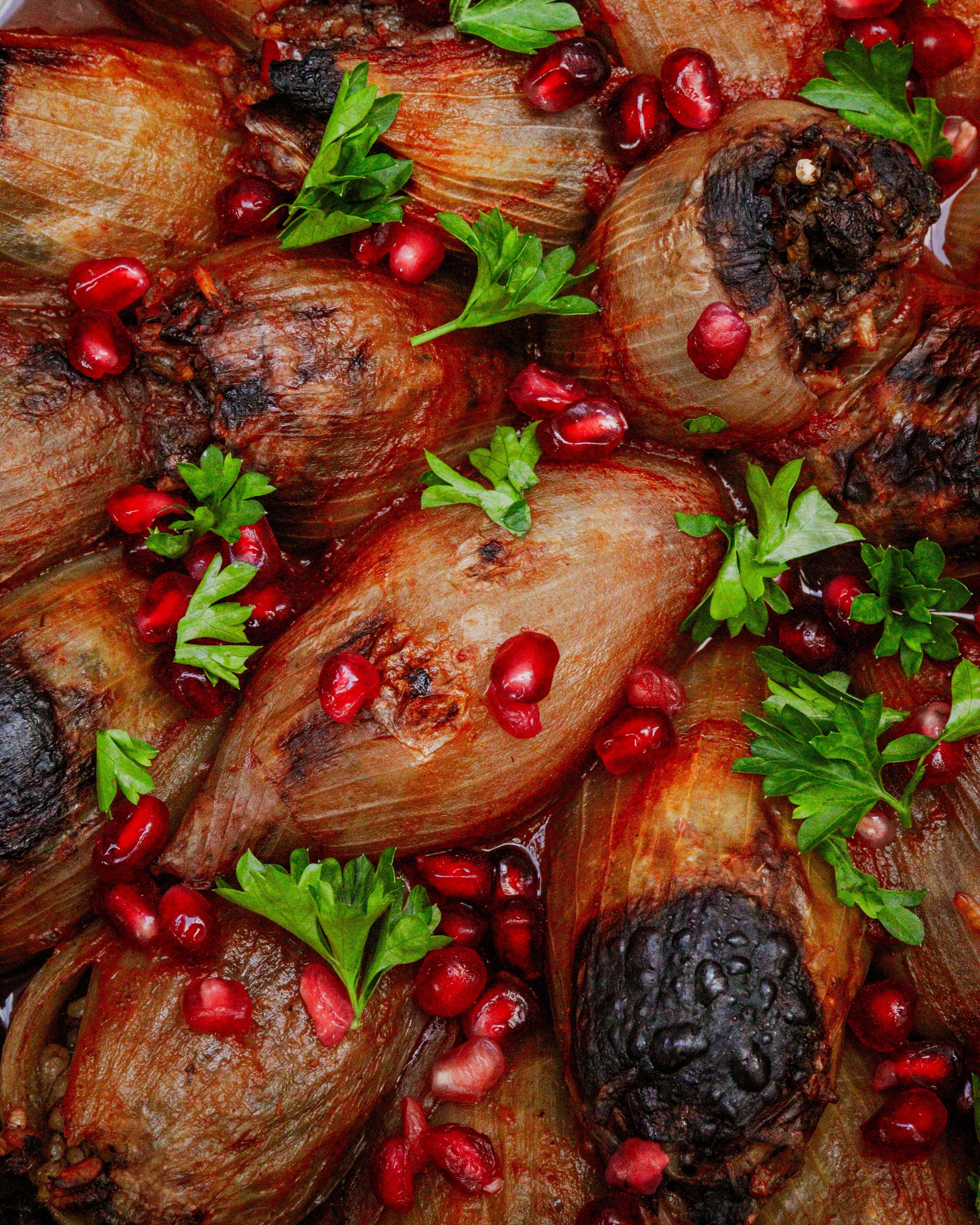
The ownership arguments around dolma are famously fierce, occasionally reaching the level of actual diplomacy. I have no interest in refereeing them. What strikes me instead is the opposite point. A dish does not spread across two thousand kilometres and a dozen languages because of empires alone. It spread because people used to live alongside each other: Armenians and Turks and Greeks and Arabs and Kurds and Jews in the same cities, buying at the same markets, living in the same apartment buildings. For centuries they were cooking within smelling distance of one another.
It is fascinating that you can read that history in the fillings. Move across the map and the rice stays but the seasoning shifts: allspice and cinnamon here, dill and lemon there, mint and pomegranate in one place, sour plum or barberry in another, chestnuts and currants in the Ottoman palace versions. It seems like different accents of the same shared language.
The stuffed onion in particular is loved across this whole territory. Think of this recipe as a paraphrase of a very old sentence.
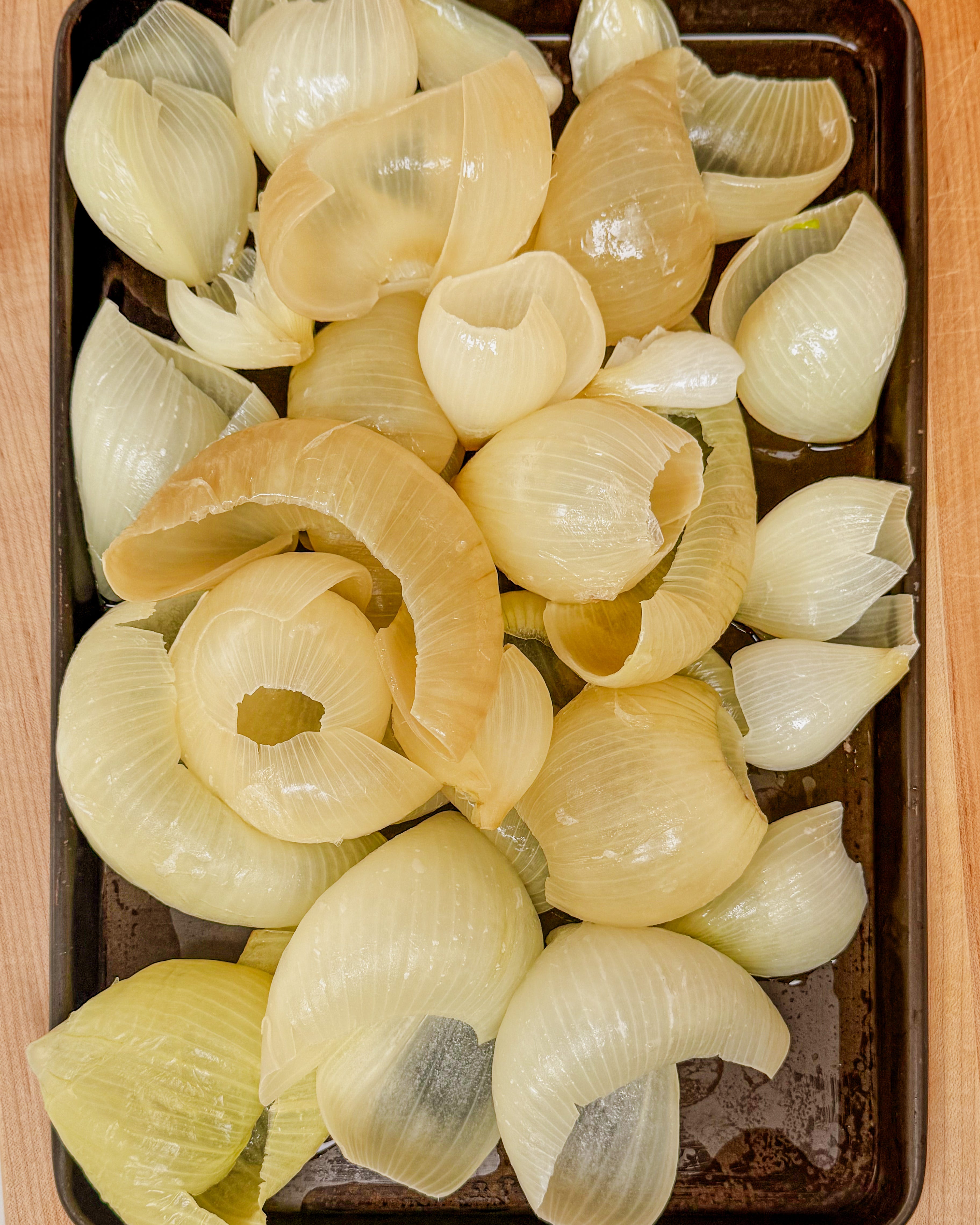
There is half a teaspoon of ground coffee in the filling. I would like to defend it before anyone decides I have made a mistake.
It is a Syrian move, one of my favourite pieces of kitchen intelligence in the whole regional repertoire. Look at what is going on in this dish: pomegranate molasses in the filling, more in the sauce, lemon juice in both, grated tomato, tomato paste. That is a great deal of acidity and it is exactly what makes yalanji so refreshing. But it can also make a dish feel thin and one-directional, all brightness and no gravitas.
The coffee supplies exactly that. Half a teaspoon disappears completely – nobody eating this will say “coffee”.
It puts something dark and roasted and faintly bitter underneath everything else. The sourness suddenly has something to push against. It rounds the whole dish downwards. It is doing the job that long cooking of meat and bones would do in the meat version and that is rather the point: the ‘impostor’ needed a way to find depth without meat and some smart mind, at some stage, centuries ago, reached for the coffee pot.
Use ground coffee, not instant. Do not be tempted to add more. This is a seasoning, not a flavour.
Every cook who has made dolma knows the anxiety of it.
Vine leaves tear at the moment you are rolling them. Courgettes and aubergines have to be hollowed out and there is always a hole that goes through the side (you patch it and hope). Peppers slump. Cabbage leaves fight back. It is enjoyable work, but it is careful work. It is why dolma-making was traditionally a job for several pairs of hands and a meditative afternoon.
The onion is the exception. The onion is kind.
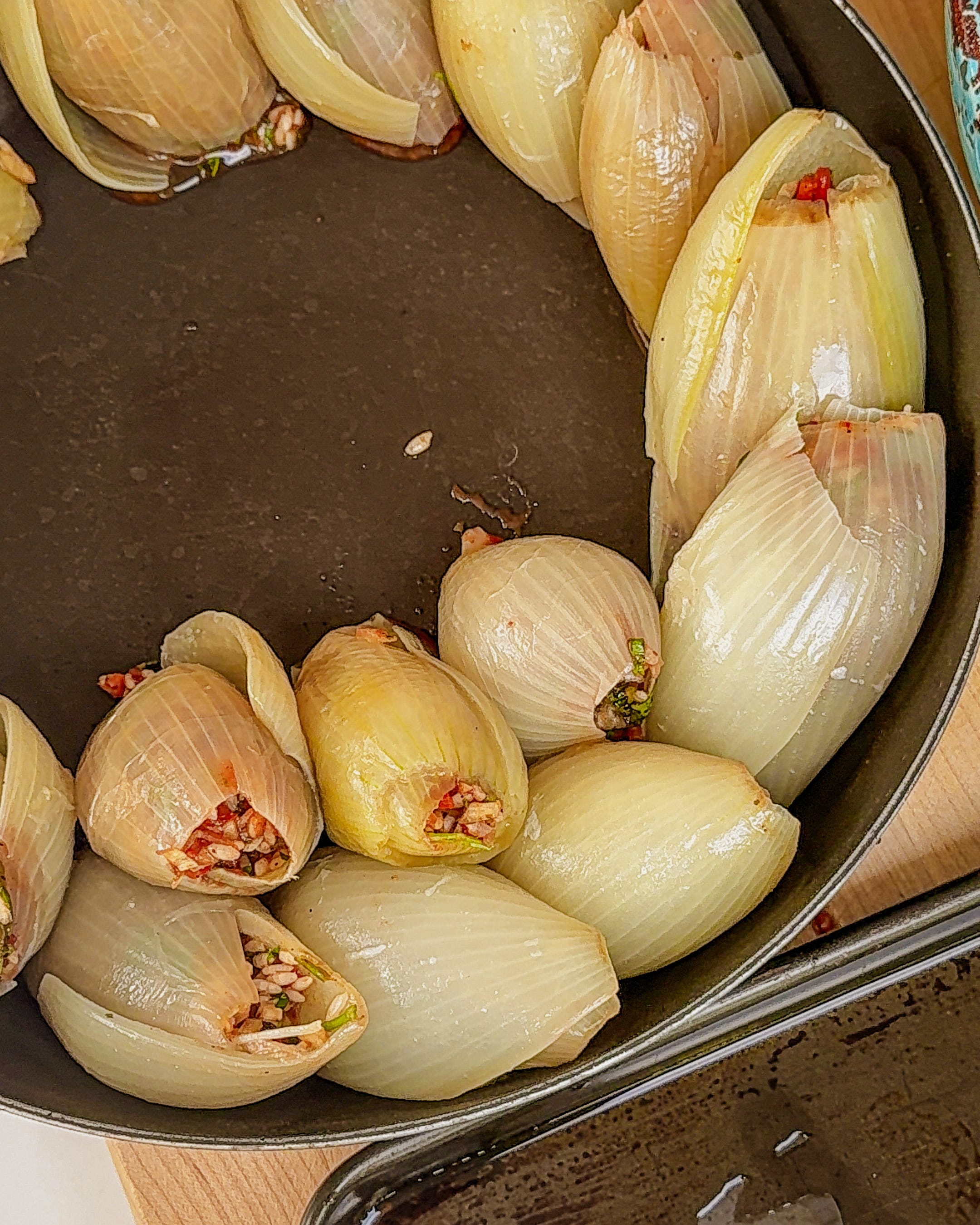
You boil it whole, having cut a slit down one side and something quite lovely happens: the layers loosen and slide apart from one another, each one comes away as a curved, glossy, slightly translucent shell that is already exactly the shape it needs to be. Spoon the filling into the hollow of the curve, roll it closed and it holds. No tearing, no patching, no tension. It is the only member of the dolma family that seems to actively want to be stuffed.
There is something I like about that. The onion is not a vegetable anybody makes a fuss over. Nobody photographs it. It is the thing you buy without thinking, in a bag, to be chopped and disappeared into the base of everything else. Here it turns out to be the most generous of vegetables – it gives up its structure willingly, sweetens as it bakes and ends up a hero rather than the foundation underneath something else.
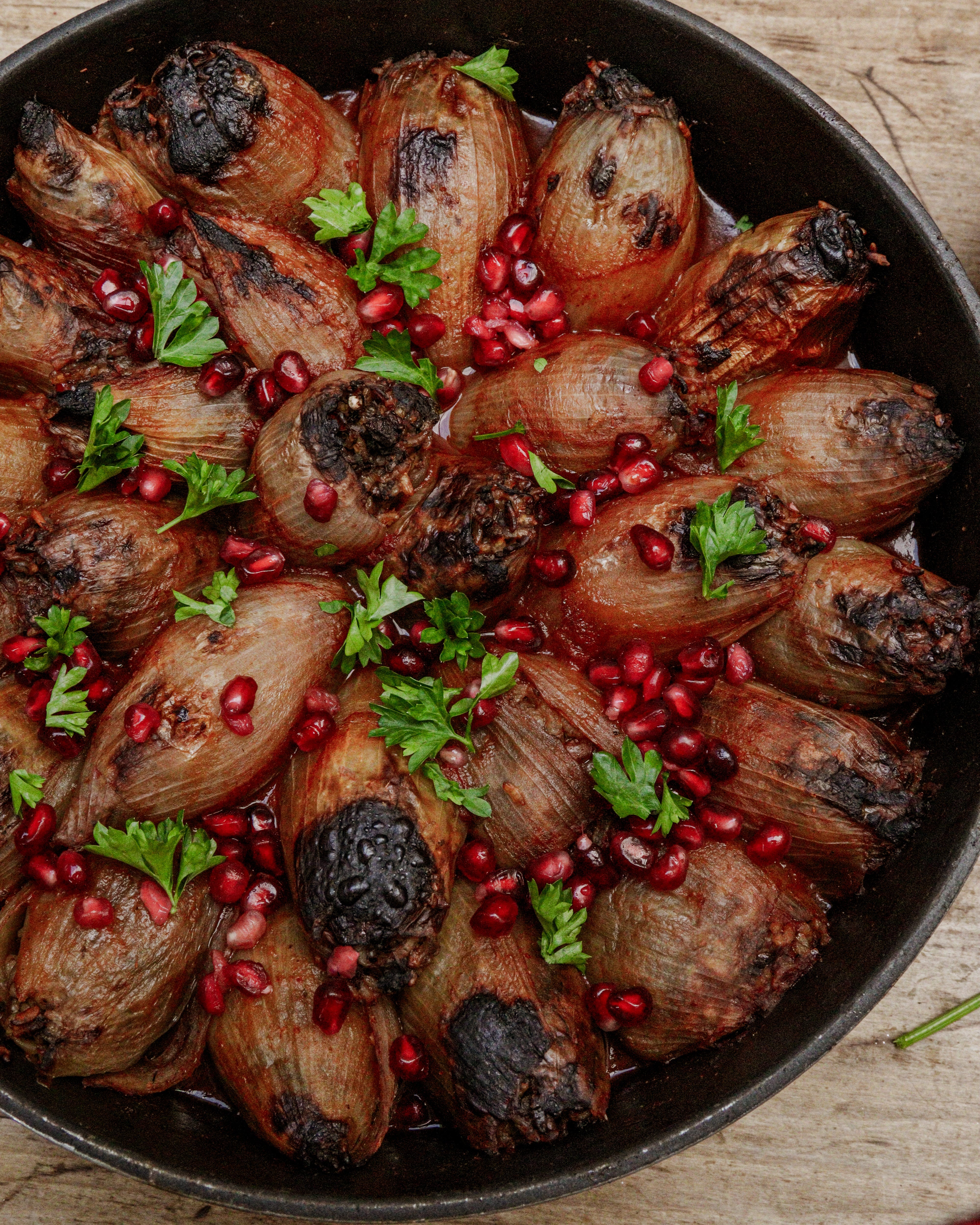
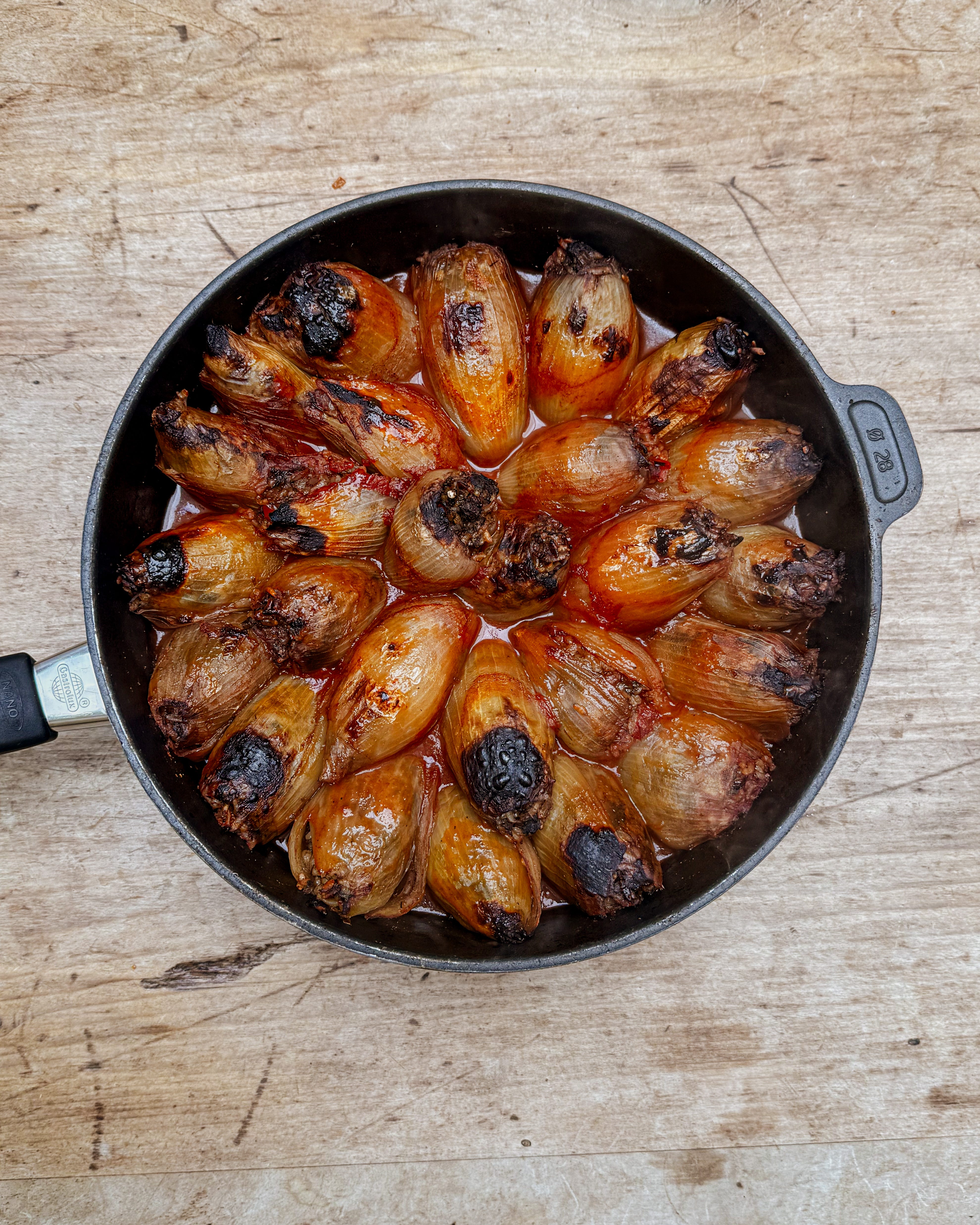
Make it today. Bake it, brown the tops, let it cool in its pan. Then eat it, or (I will always choose this option) cover and put it in the fridge. Tomorrow the rice will have finished drinking the sauce, the sourness will have settled, the olive oil will have carried all the herbs everywhere and all the flavours will have rounded. Take it out half an hour before you want it, scatter over pomegranate seeds and put a bowl of cold yoghurt beside it. Eat it outside if you can.
Yalla, let’s make it.
RECIPE: Stuffed Onion Yalanji
Serves 4-6
INGREDIENTS: